

 By John Hyams
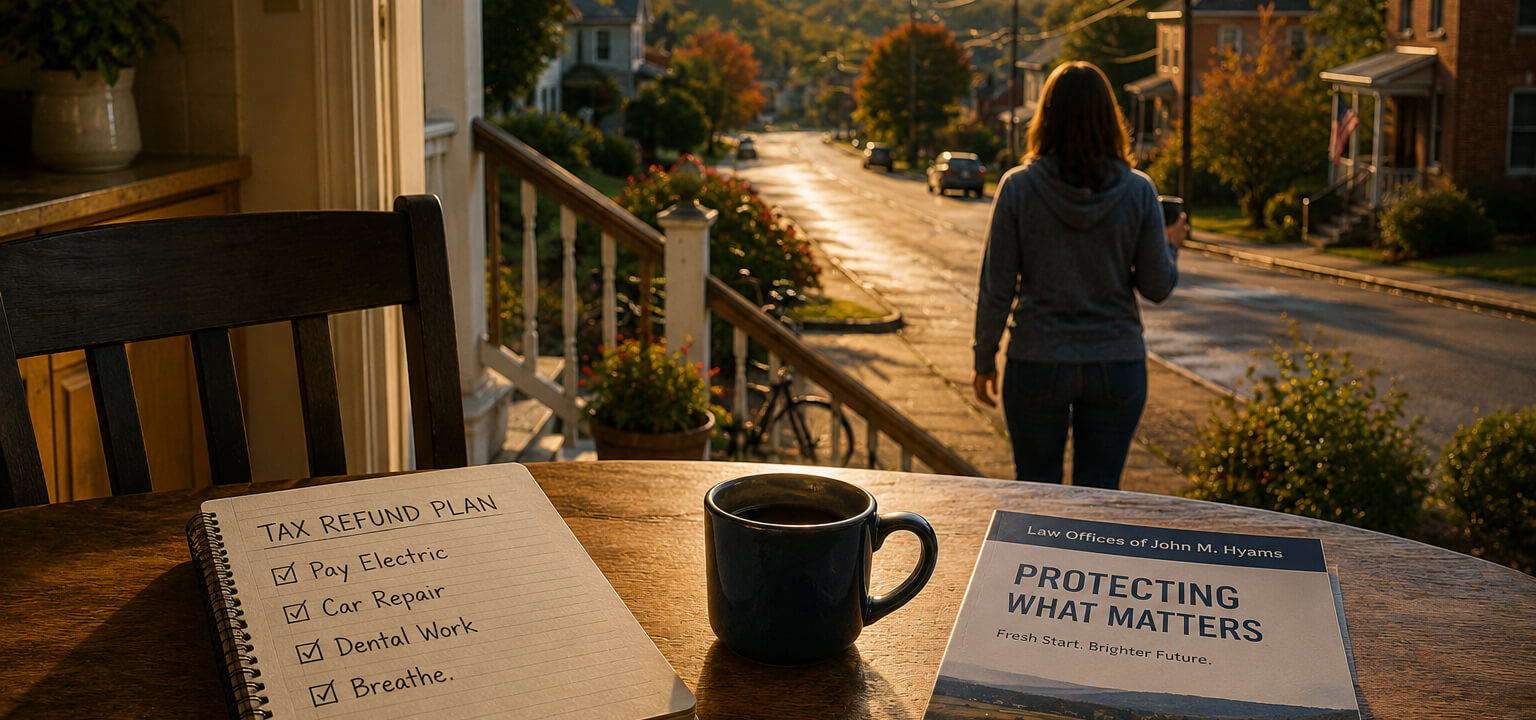
For many Central Pennsylvania families, the tax refund that arrives between January and May is the single largest deposit of the year. It is the money earmarked for the broken transmission, the past-due electric bill, the long-overdue dental work, or simply the chance to breathe for the first time in months. So when someone considering bankruptcy hears the words “the trustee can take your refund,” the panic is immediate and entirely understandable.
Here is the truth that gets lost in those scary-sounding warnings: with the right exemption strategy and proper filing timing, most people who file bankruptcy protect most or all of their tax refund. The rules are not designed to punish you. They are designed to be navigated, and that is exactly what an experienced bankruptcy attorney does. This guide explains how tax refunds are treated, the federal exemptions that protect them, and the timing decisions that often make the difference between losing a refund and keeping every dollar.
Why Trustees Are Interested in Your Tax Refund
When you file a bankruptcy case, almost everything you own on the date of filing becomes part of what the law calls the bankruptcy estate. A bankruptcy trustee is appointed to review that estate and identify any non-exempt assets that could be liquidated to pay creditors. According to the U.S. Department of Justice’s overview of trustee duties, one of the trustee’s core responsibilities is collecting and accounting for property of the estate.
A tax refund counts as property of the estate to the extent it was earned before you filed. Here is the part that catches people off guard: even if you have not yet filed your return or received the refund on the day you file bankruptcy, the trustee is still entitled to the portion of the refund attributable to income you earned in the period before your filing date.
This is called pro-rata treatment. If you file bankruptcy on October 1, the trustee has a claim on roughly nine-twelfths of any refund you eventually receive for that tax year, because nine months of the tax year had already passed when you filed. People who file in January or February are often filing right when the prior year’s full refund is sitting in the bankruptcy estate, which is why tax season is one of the most strategically sensitive times of year to file.
The trustee is not being aggressive or unfair by asking about refunds. They are doing their job. Your job, with help from your attorney, is to make sure every dollar that can be exempted is exempted.
The Exemption Strategies That Actually Work
Pennsylvania is one of the states that lets bankruptcy filers choose between state exemptions and the federal bankruptcy exemptions under 11 U.S.C. § 522(d). For nearly all Pennsylvania filers protecting a tax refund, the federal exemptions are the better choice. Here is why.
The Federal Wildcard Exemption
This is the workhorse for tax refund protection. As of cases filed on or after April 1, 2025, the federal wildcard exemption gives every filer $1,675 of protection that can be applied to any property, including cash and tax refunds. On top of that, you can add up to $15,800 of any unused portion of the federal homestead exemption. If you do not own a home, or if you have little to no equity in the home you do own, you can stack that unused homestead amount onto the wildcard. That gives a single filer up to $17,475 in flexible protection, and a married couple filing jointly up to $34,950. These figures apply to cases filed between April 1, 2025, and March 31, 2028, when they will adjust again for inflation.
Why Federal Usually Wins for Refund Protection in Pennsylvania
Pennsylvania’s state exemption scheme is comparatively limited. There is no state homestead exemption, no state motor vehicle exemption, and no robust wildcard. For a filer whose primary asset to protect is a tax refund or modest cash savings, federal exemptions almost always provide more coverage. The Pennsylvania state exemption statutes at 42 Pa.C.S. § 8124 are useful in narrow circumstances, but most Central PA bankruptcy clients fare better choosing the federal scheme. We walk through that comparison case by case in our guide to Pennsylvania vs. federal bankruptcy exemptions.
Stacking Exemptions for Married Couples
Married couples who file jointly can double every federal exemption amount. That means two wildcards, two unused-homestead add-ons, and roughly $34,950 of flexible protection that can be aimed squarely at a tax refund if needed. For a couple expecting a five-figure refund, that doubling is often the entire ballgame.
Timing Your Filing: The Single Biggest Lever
Timing is where an experienced attorney earns their fee many times over. The same refund, the same financial situation, and the same exemptions can produce wildly different outcomes depending on when you file.
Filing Before You Receive the Refund
If you file bankruptcy in February with a $4,500 refund still sitting at the IRS, the entire refund (or the pre-filing portion of it) is property of the estate. You will need exemptions to cover it. For most filers using the federal scheme, that is doable. But if you have other cash savings or a paid-off vehicle eating into your wildcard, the math gets tighter.
Filing After You Receive and Spend the Refund
This is often the cleanest approach. If you receive your refund in March and then spend it on legitimate, necessary expenses (catching up on rent, paying medical bills, repairing your car so you can keep getting to work), there is nothing left for the trustee to claim. You then file in late spring or summer with a clean slate. The key word is “necessary.” We will come back to that.
Why Post-Filing Refunds Are Yours
This is one of the most welcome rules in bankruptcy. Income you earn after your filing date is not part of the bankruptcy estate. So a refund attributable to wages you earn after filing belongs entirely to you. People who file at the end of one calendar year often keep the entire refund they receive the following spring, because those withholdings were associated with post-filing income. The pro-rata math runs both directions, and that can work strongly in your favor.
The Earned Income Tax Credit and Child Tax Credit
For working families, refundable tax credits can be the largest piece of the refund. The two big ones are the Earned Income Tax Credit and the refundable portion of the Child Tax Credit (the Additional Child Tax Credit, or ACTC).
These credits get special, favorable treatment in bankruptcy under federal exemptions. The EITC and ACTC are designed by Congress to support low- and moderate-income working families. Many federal courts treat them as needs-based public assistance benefits, and even when they are pulled into the estate, the federal wildcard typically covers them comfortably. For a single parent with two kids and a modest income, a $6,000 to $8,000 EITC plus ACTC refund is often fully protected by the wildcard plus unused homestead amount, with room to spare.
Spending the Refund Responsibly Before Filing
If your strategy is to receive and spend the refund before filing, what you spend it on matters enormously. Trustees have seen every variation of this. Reasonable, necessary, documented spending is fine. Anything that looks like asset-shifting or preferential treatment of certain creditors is not.
Generally safe spending categories:
- Past-due rent or mortgage payments
- Utility bills and required deposits
- Necessary car repairs
- Medical and dental expenses, including deductibles and copays
- Groceries and household necessities
- Reasonable clothing for work or school
- Bankruptcy attorney fees and filing fees
What to avoid:
- Luxury goods (a new TV, vacation, jewelry, recreational purchases)
- Paying back family members or friends (a preference the trustee can claw back)
- Paying off one credit card while leaving others unpaid
- Buying assets that won’t be exempt (a paid-off second vehicle, for instance)
- Large cash withdrawals with no documentation
The principle is simple. The refund existed to help you live. Use it to live, document everything, and you will be fine.
Chapter 13 and Annual Refunds
Chapter 13 bankruptcy involves a three- to five-year repayment plan, which means the question of tax refunds is not a one-time event. Trustees in different districts have different policies, and the Middle District of Pennsylvania (which covers Harrisburg, Lancaster, York, and the surrounding counties) has its own approach.
In many Chapter 13 cases, the trustee asks the debtor to turn over annual tax refunds during the life of the plan, with that money typically increasing the dividend paid to unsecured creditors. There are several ways to manage this:
- Modify the plan. Some debtors front-load their plan payments slightly higher in exchange for the trustee waiving the refund-turnover requirement. This is negotiated case by case.
- Reduce withholding. Adjusting your W-4 so that less tax is withheld during the year can reduce or eliminate the refund itself, putting that money in your monthly budget instead. Be careful not to underwithhold, which can create a tax liability.
- Request to keep refunds for genuine necessities. Most Chapter 13 trustees will allow a debtor to keep a refund (or part of one) when the funds are needed for a documented emergency: a furnace replacement, an unexpected medical expense, a critical car repair. This requires a written request and supporting documentation.
The point is that even in Chapter 13, refunds are not automatically lost. They are managed.
Documenting Everything
Whether you file Chapter 7 or Chapter 13, the 341 Meeting of Creditors is where the trustee asks questions about your finances under oath. If your refund came up as part of your case, you may be asked what it was, when you received it, what you spent it on, and where any remaining funds are held.
This is not a hostile interaction. It is a recordkeeping moment. Filers who walk in with receipts, bank statements, and a clear account of where the money went finish the meeting in fifteen minutes. Filers who cannot account for thousands of dollars in deposits and withdrawals invite scrutiny and follow-up requests.
Save receipts. Keep records. If you spent the refund, prove what you spent it on. Honest, documented records protect you.
A One-Hour Consultation Can Be Worth Thousands
Tax refund timing is one of the clearest examples of why the Law Offices of John M. Hyams does not recommend handling bankruptcy with form-filling software or a generalist attorney who files one or two cases a year. The difference between filing on January 20 versus April 15, or choosing federal versus state exemptions, can mean keeping or losing thousands of dollars that you have already worked hard to earn.
John Hyams has spent over twenty years exclusively practicing bankruptcy law and has been honored as one of Harrisburg Magazine’s “Simply the Best” attorneys in 2020, 2024, and 2025. With seven Central Pennsylvania office locations and free consultations available in person, online, or by phone, getting straight answers about your specific refund situation is easier than you think.
Time Your Filing to Protect Your Refund
If you are anticipating a refund and worried about losing it, the right time to plan is now. We will look at your numbers, your situation, and your goals, and build a plan to keep as much of your refund as the law allows.
Schedule Your Free Consultation
Frequently Asked Questions
Most Pennsylvania filers protect most or all of their tax refund using the federal wildcard exemption, which provides $1,675 plus up to $15,800 of unused homestead amount in cases filed between April 1, 2025, and March 31, 2028. Married couples filing jointly can double those figures. Whether your specific refund is fully protected depends on your other assets and your exemption choices.
This is a case-by-case decision. Filing after you receive and reasonably spend the refund on necessary expenses often produces the cleanest outcome. Filing before, with the right exemptions claimed, also works well for many filers. An experienced bankruptcy attorney can model both options against your specific numbers.
Refundable credits like the Earned Income Tax Credit and the Additional Child Tax Credit receive favorable treatment in bankruptcy. Many courts treat them as needs-based benefits, and the federal wildcard exemption typically covers them in full for working families. The exact protection depends on your exemption strategy and total refund amount.
Yes, on reasonable, necessary expenses. Catching up on rent, paying medical bills, fixing your car, or covering basic living costs are all generally acceptable. Avoid luxury purchases, paying back family or friends, paying one creditor over others, or large undocumented cash withdrawals, as these can create problems with the trustee.
Chapter 13 trustees in the Middle District of Pennsylvania often request annual refund turnovers during the three- to five-year plan, but options exist. Filers can sometimes modify their plan, adjust their tax withholding, or request to keep refunds for documented necessities like emergency repairs.
Pennsylvania has no state homestead exemption, no state motor vehicle exemption, and only a limited wildcard. The federal scheme provides a generous wildcard that can be aimed at cash and tax refunds, plus the ability to stack any unused homestead amount on top. For most Pennsylvania bankruptcy filers, the federal exemptions protect significantly more property.
Pro-rata treatment means the bankruptcy estate is entitled to the portion of your refund attributable to income you earned before your filing date. If you file on October 1, roughly nine-twelfths of that year’s refund is pre-filing property. Refunds tied to post-filing income belong entirely to you.
If your refund is part of your case, the trustee may ask what you received, when, and what you spent it on. Bringing bank statements and receipts that show how the funds were used on legitimate expenses makes the meeting straightforward. Honest documentation is your best protection.